Alchemy
What Does Alchemy Actually Mean? The Practical Guide to Personal Change
Understand the historical definition, the psychological meaning, and how to use transmutation to change your life today.
7 min read
What does alchemy actually mean? Historically, alchemy was an ancient branch of natural philosophy focused on turning base metals like lead into gold, finding a universal cure for disease, and discovering the secret to eternal life. Today, however, the real meaning of alchemy has evolved. It is a powerful psychological and practical metaphor for self-transformation. It is the conscious process of taking your raw, difficult life experiences—such as stress, career setbacks, or limiting beliefs—and transmuting them into wisdom, strength, and personal power. Instead of trying to escape your current reality, personal alchemy teaches you how to work with the raw material you already have to build a more authentic and impactful life.
The Historical Roots of Alchemy
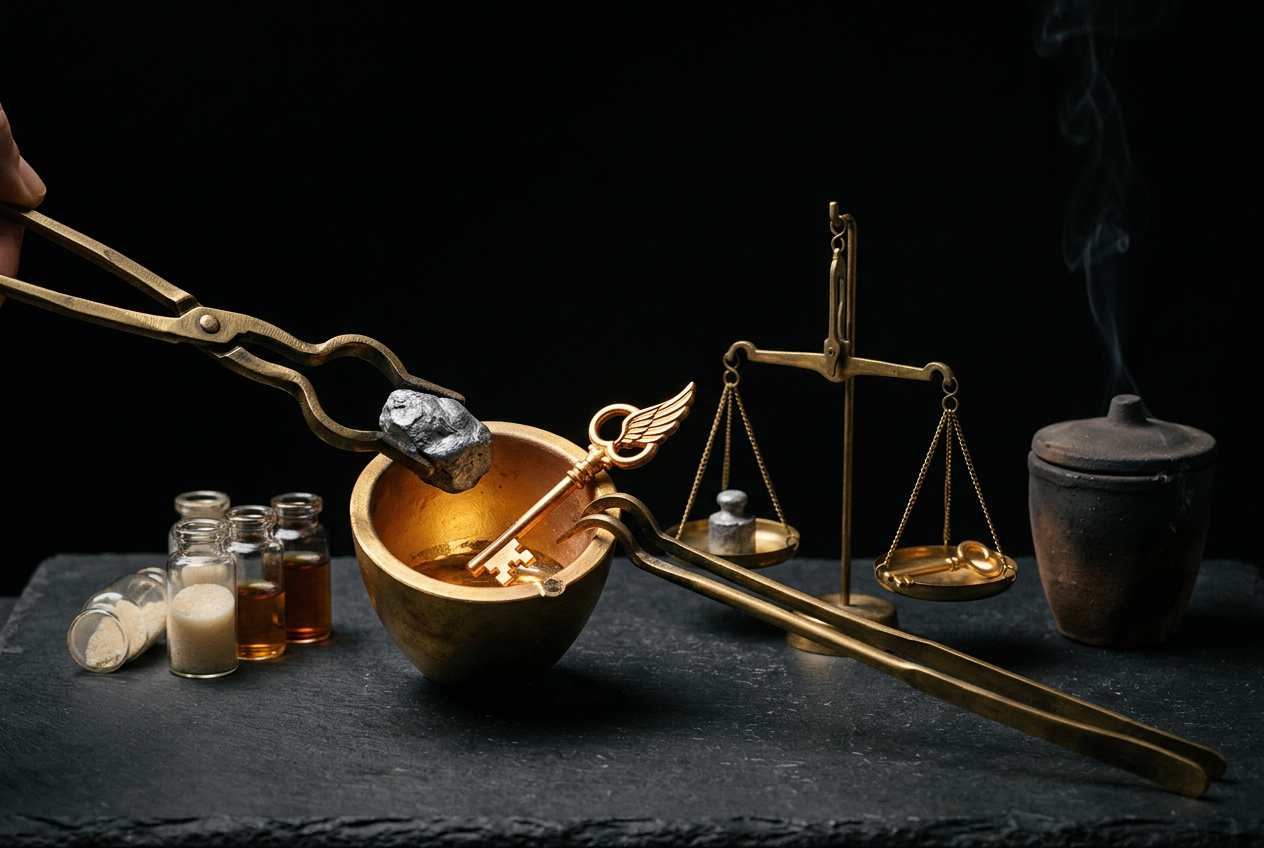
To understand how alchemy applies to your daily life today, it helps to look at where it started. For thousands of years, practitioners across ancient Egypt, Greece, India, China, and medieval Europe engaged in physical alchemy. These early alchemists were the predecessors of modern chemists. They spent their lives in dark laboratories surrounded by furnaces, glass vials, and heavy metals.
Their goals were highly ambitious. They sought the Philosopher’s Stone, a legendary substance capable of turning inexpensive base metals like lead or iron into precious gold. They also searched for the Elixir of Life, a potion that would grant youth and immortality.
However, physical alchemy was never purely about material wealth. For many practitioners, the physical laboratory was a reflection of their own inner development. The purification of metals mirrored the purification of the human soul. They believed that the universe was interconnected, and by understanding how to refine natural elements, they could learn how to refine themselves.
The Psychological Shift: Carl Jung and Inner Gold
As the scientific revolution took hold, chemistry replaced alchemy as a physical science. But alchemy did not disappear; instead, it moved inward. In the twentieth century, Swiss psychiatrist Carl Jung rescued alchemy from the dusty shelves of history.
Jung realized that the bizarre symbols and complex formulas in ancient alchemical texts were actually expressions of human psychology. He argued that the alchemists were unconsciously projecting their own internal mental processes onto their chemical experiments.
In Jungian psychology, the journey of turning lead into gold is a metaphor for "individuation"—the process of becoming a whole, integrated human being. Your "lead" represents your shadow, your unexamined habits, and your painful emotional wounds. Your "gold" represents self-awareness, maturity, and your unique, fully realized potential. By facing the dark, messy parts of your mind, you can extract the valuable lessons hidden within them.
What is Transmutation? The Core Principle of Change
At the absolute center of alchemy is the concept of transmutation. Transmutation is not simply changing one thing into another; it is the fundamental restructuring of an existing element into a higher, more valuable state.
Many people approach personal growth through the lens of elimination. They want to cut out their anxiety, delete their bad habits, and forget their painful pasts. But alchemy offers a different path. It suggests that you cannot truly destroy your experiences or emotions; you can only change their form.
When you practice modern alchemy, you stop trying to run away from your difficult emotions or tough circumstances. Instead, you look at them as raw fuel. For example, you can learn how to practice Modern Alchemy: How to Turn Your Hardest Moments into Usable Power by taking the heavy weight of a difficult experience and reshaping it into a boundary that protects your peace. Transmutation is the art of using the energy of your challenges to power your personal growth.
Everyday Alchemy: A Concrete Example of Transmutation
To see how this works in real life, let’s look at a common scenario. Imagine a professional named Sarah. Sarah has worked at the same company for five years, dedicating her evenings and weekends to her projects. One afternoon, her department is downsized, and she is laid off.
Sarah's immediate reaction is a mix of anger, fear, and worthlessness. This is her "lead"—the heavy, toxic emotion of rejection and sudden instability.
A standard approach might be to spiral into self-doubt or jump immediately into another unfulfilling job just to escape the anxiety.
An alchemical approach is different. Sarah decides to sit with her raw material. She separates the facts from her emotions. She realizes her anger is actually a sign that she valued her own hard work more than her employer did. She transmutes that anger into professional boundaries and uses her past experiences as leverage. She targets roles that offer more autonomy and better pay. By applying Career Alchemy: How to Turn Hard Work into Professional Leverage, she turns a painful career setback into the exact catalyst she needed to level up her professional life.
The Three Phases of Personal Transformation
Ancient alchemists talked about several stages of transformation, but they can be simplified into three primary phases that you can apply to your life today.
The first phase is Nigredo, or the black work. This is the stage of breakdown, decomposition, and facing the shadow. In personal growth, this is the moment you admit something isn't working. It is uncomfortable, dark, and often feels like a crisis, but it is necessary to clear away the old structures that no longer serve you.
The second phase is Albedo, or the white work. This is the stage of purification, washing, and reflection. Here, the chaos of the Nigredo settles. You begin to look at your life objectively, separate your true self from your patterns, and gain clear insight into who you want to become.
The third phase is Rubedo, or the red work. This is the stage of integration, action, and realization. You take the lessons from the dark times and the clarity from the reflective times and bring them together into a lived, active reality. You are no longer just thinking about change; you are living it.
Transformation does not require you to become a completely different person; it requires you to extract the value already hidden within your life.
Four Steps to Practice Daily Personal Alchemy
You do not need a laboratory or a degree in psychology to start using alchemy in your life. You can practice it every day by following these four practical steps:
- Identify the Lead: Name the heavy, difficult emotion or situation you are currently facing. It could be anxiety about your finances, frustration with a relationship, or feeling stuck in your routine.
- Separate and Purify: Distinguish between the external facts of the situation and your internal reactions. Strip away the self-criticism and judgment so you can look at the raw material clearly.
- Look for the Gold: Ask yourself, "What is the hidden value in this challenge?" If you are experiencing deep frustration at work, that frustration is valuable data showing you exactly where your boundaries are being crossed.
- Transmute Through Action: Convert that emotional energy into a constructive, real-world action. Use your anger to set a clear boundary, or use your fear as a signal to prepare more thoroughly for an upcoming goal.
Why the Alchemical Metaphor Matters in the Modern World
Our modern culture is obsessed with quick fixes, instant manifestations, and overnight success. We are told to ignore our struggles, think positive thoughts, and push through our exhaustion. But this approach rarely leads to lasting change because it ignores our actual reality.
Alchemy matters today because it respects our struggles. It tells us that our challenges are not mistakes or detours; they are the very material required for our development.
To make these transformations stick, we have to move beyond temporary motivation. Real growth requires structured processes. Embracing The Shift to Systems: Advanced Alchemy for Lasting Change ensures that your personal development isn't dependent on fleeting willpower, but on repeatable, practical habits that support your daily life.
This systematic, realistic view of transformation is at the heart of "The Alchemized Principles of Power" by Brittany Johnson. It reminds us that real power is not about escaping our human limitations, but about learning how to work with them intentionally to shape our own outcomes.
Frequently Asked Questions
What is the literal meaning of alchemy?
Historically, alchemy was an ancient philosophy and early science focused on transmuting base metals into gold, creating a universal panacea for healing, and discovering an elixir for longevity. It combined elements of metallurgy, chemistry, philosophy, and mysticism.
How is alchemy used as a metaphor for personal growth?
In personal growth, alchemy represents the process of inner transformation. It means taking the "lead" of your life—challenges, painful memories, and fears—and consciously refining them into the "gold" of wisdom, confidence, and personal resilience.
Is modern alchemy a form of magic or superstition?
No, modern alchemy is a purely practical and psychological framework. It does not promise supernatural outcomes or physical miracles; rather, it uses the historical language of transformation to help people understand cognitive reframing, emotional regulation, and intentional behavioral change.
How do I know if I am in the Nigredo stage of transformation?
You are likely in the Nigredo phase if you feel overwhelmed, confused, or like an old way of living is falling apart around you. While this stage is emotionally heavy, it is a healthy sign that your mind is preparing to break down outdated habits so you can build better ones.