Alchemy
The Meaning of the Philosopher's Stone: A Modern Guide
Discover what the legendary philosopher's stone actually symbolized and how to use its lessons to turn life's challenges into value.
6 min read
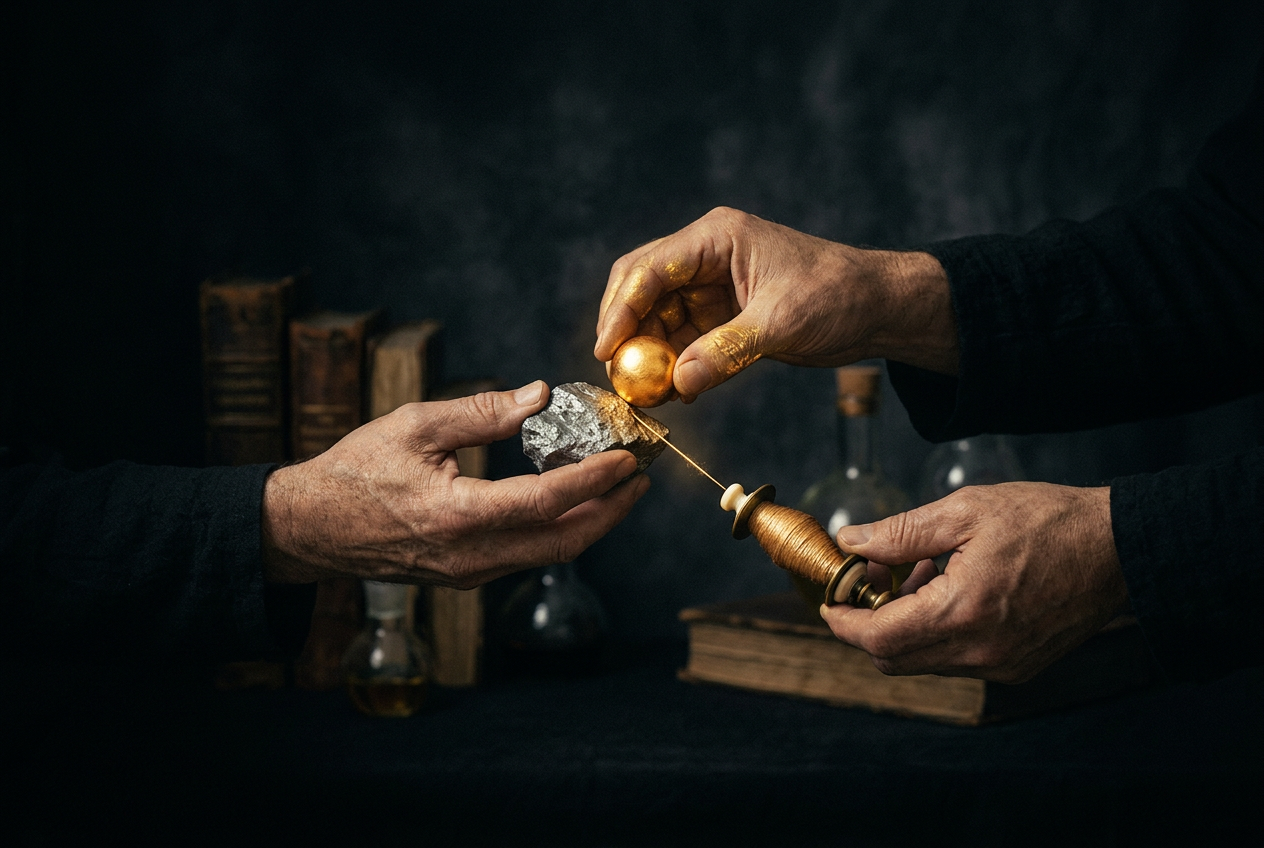
Historically, the search for the philosopher's stone was the ultimate quest of alchemy. Legends claimed this elusive substance could transmute base metals into gold and grant physical immortality. However, the true philosophers stone meaning is not supernatural or physical. It is a profound psychological and emotional metaphor.
In practical terms, the philosopher’s stone represents the personal capacity to convert any life experience—including pain, failure, and setbacks—into wisdom, resilience, and personal value. It is the mental and emotional toolkit that allows you to take raw, difficult circumstances and refine them into usable power. Rather than a magical object, the stone is a developed state of self-mastery that turns life’s challenges into your greatest assets.
The History Behind the Myth
For centuries, laboratory alchemists worked over bubbling cauldrons and complex glass apparatuses. They spoke in riddles, drew strange symbols, and wrote recipes for a legendary substance they called the Lapis Philosophorum, or the philosopher's stone. To the uninitiated observer, these early scientists seemed obsessed with material wealth. They wanted to take cheap lead and turn it into expensive gold.
But if you dive deeper into historical texts, you quickly realize that the literal laboratory work was often a cover. In eras when questioning religious or political authorities could cost you your life, thinkers had to hide their philosophical ideas in plain sight. To learn What Does Alchemy Actually Mean? The Practical Guide to Personal Change, we have to look past the physical crucibles. The real work was happening inside the alchemist's own mind. They used the chemical processes of purification, dissolution, and recombination to explain the messy, painful process of human growth.
The True Philosophers Stone Meaning
If the philosopher's stone isn't a physical rock, what does it actually represent? In ancient traditions, the stone was often referred to as "the stone that is not a stone." It was a symbol of integrated consciousness.
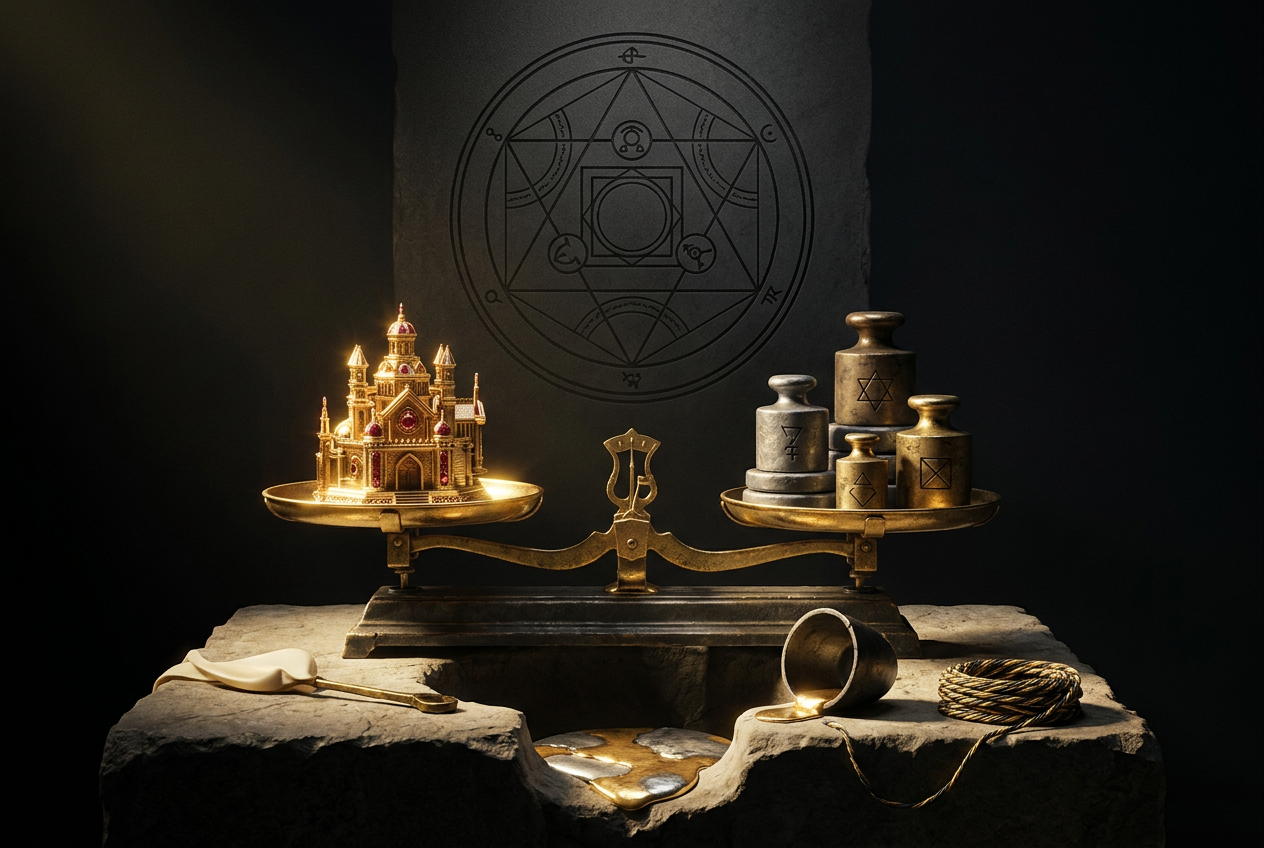
In classical alchemy, the symbol of the philosopher's stone is often depicted as a squared circle: a triangle inside a square, surrounded by a circle. Each shape represents a different layer of human existence:
- The Square represents the physical world, our daily habits, and our bodily experiences.
- The Triangle represents our mind, spirit, and conscious intention.
- The Circle represents wholeness, infinity, and the ultimate integration of the self.
When you bring these elements together, you get the philosopher's stone: a mind so unified and resilient that it cannot be broken by external events. It is a state of psychological maturity where you no longer react blindly to what happens to you. Instead, you process your experiences through a lens of wisdom, extracting the lessons and leaving the bitterness behind.
How Modern Alchemy Translates the Legend
Today, we do not need to burn coal or mix sulfur to practice alchemy. We face a different kind of base metal: the daily friction of modern life. We deal with broken relationships, career setbacks, financial stress, and internal self-doubt. These are our "lead."
The modern philosopher's stone is the mental framework that allows you to look at these difficult situations and ask: How can I use this to grow?
This isn't about toxic positivity or pretending that bad things are secretly good. It is about practical utility. When you suffer a setback, you have every right to feel hurt or disappointed. But once the initial shock wears off, you have a choice. You can let the experience harden into resentment, or you can use it as raw material to build a stronger character. Learning this process is the core of Modern Alchemy: How to Turn Your Hardest Moments into Usable Power.
"The philosopher's stone is not a physical gem you find in the earth; it is the mental filter you build to turn raw hardship into refined wisdom."
An Everyday Example of the Stone in Action
To understand how this works in real life, let’s look at a concrete example. Consider Sarah, a graphic designer who spent five years working for a mid-sized marketing firm. She was loyal, worked long hours, and expected a promotion. Instead, due to sudden corporate restructuring, she was laid off.
A non-alchemical response to this situation might involve months of bitterness, blaming the company, and feeling like a victim of circumstances. While those feelings are completely natural at first, staying in that state keeps you trapped in the "lead" phase.
Sarah, however, decided to apply a modern alchemical mindset. Once she processed her initial grief, she looked at her situation objectively. She realized that her employment had kept her comfortable but stagnant. She used her severance pay to take an advanced course in user experience (UX) design—a high-paying skill she had ignored for years. Within six months, she secured a freelance contract that paid double her previous hourly rate.
This shift is a perfect example of Career Alchemy: How to Turn Hard Work into Professional Leverage. Sarah didn't rely on magic. She took the raw, heavy lead of a layoff and used it as the exact catalyst she needed to build professional independence.
Step-by-Step: How to Build Your Own Stone
Developing this mental capacity does not happen overnight. It is a daily practice, a habit of mind that you build through conscious repetition. Here is a simple, actionable process you can use whenever you face a difficult situation:
- Acknowledge and Name the Raw Material: Don't try to suppress your emotions. If you are angry, sad, or frustrated, let yourself feel it. Acknowledge the situation for what it is without sugarcoating it.
- Separate the Facts From the Story: Look at the event objectively. What are the bare facts, and what is the painful story you are telling yourself about those facts? For example, "I was let go" is a fact; "I will never find a good job again" is a story.
- Ask the Alchemical Question: Shift your focus by asking: "How can I use this experience to my advantage?" or "What does this situation require me to develop?"
- Extract the Wisdom and Discard the Waste: Keep the lesson, the skill, or the resilience you gained. Let go of the anger, the blame, and the regret.
- Take Immediate, Small Action: Apply your new insight to a small, real-world task. This anchors the transformation in your daily life.
By practicing these steps regularly, you can begin using Mental Alchemy: How to Rewire a Default Thought Pattern to change how you react to stressful events automatically.
The Shift From Victim to Creator
Most people live in a state of reaction. They believe their happiness, success, and peace of mind depend entirely on what happens to them. If the weather is good, they are happy. If their boss is grumpy, their day is ruined. This is a fragile way to live.
When you develop your own philosopher's stone, you shift from being a passive victim of circumstances to an active creator of your own reality. You realize that while you cannot always control the events of your life, you have absolute control over how you interpret and use them.
In her book, The Alchemized Principles of Power, Brittany Johnson points out that true personal power is not about dominating others or controlling external events. It is about mastering your own inner state. When you possess this inner stability, every event becomes useful. Even your worst days contain the raw material for your future strength.
The Philosopher's Stone in Popular Culture
Most people today first meet the philosopher's stone through fiction. J.K. Rowling's first Harry Potter book was published in the UK as Harry Potter and the Philosopher's Stone (retitled Sorcerer's Stone in the US). In that story the stone is tied to Nicolas Flamel, a real fourteenth-century Parisian scribe whom later legend credited, without evidence, with making the stone and living for centuries.
The pattern in every version is the same: the stone is valuable, but the people who chase it for shortcuts lose something, and the people who understand it gain wisdom. That is the same lesson the old alchemists encoded. The stone was never really for sale.
What the Philosopher's Stone Symbolizes
Across alchemical texts, the stone carries a consistent set of meanings:
- Transmutation: the power to turn something ordinary into something of higher value.
- Completion: the end of the Magnum Opus, or Great Work, after every stage of breaking down and rebuilding.
- Unity of opposites: the joining of what seemed to be in conflict, such as reason and emotion, or discipline and desire.
- Lasting life: read psychologically, a self that is no longer at the mercy of every passing circumstance.
Even Isaac Newton spent years studying alchemical manuscripts. Serious minds took the symbol seriously because it describes something real: the human ability to refine experience into understanding.
Frequently Asked Questions
What does the philosopher's stone mean in simple terms?
In simple terms, the philosopher's stone is a symbol for the ability to turn ordinary or painful experiences into something valuable. Historically it was a legendary substance said to turn lead into gold. Psychologically, it stands for the developed inner capacity to convert setbacks into wisdom and strength.
Is the philosopher's stone real?
No physical philosopher's stone has ever been found or demonstrated. The stone is best understood as a symbol. What is real is the process it represents: deliberately working through difficult experiences until they produce insight and better decisions.
Did historical alchemists ever actually create a physical philosopher's stone?
No. Despite centuries of experimentation, no alchemist ever created a physical stone that could turn lead into gold or grant physical immortality. However, their physical experiments laid the groundwork for modern chemistry, while their philosophical writings provided deep insights into human psychology.
How does the concept of the philosopher's stone apply to mental health?
In modern psychology, the philosopher's stone is highly comparable to cognitive reframing and resilience building. It is the practice of looking at a traumatic or difficult event and finding a functional narrative that allows you to heal and grow, rather than remaining trapped in pain.
Is the philosopher's stone related to spiritual growth?
Yes. Many spiritual traditions speak of a similar inner transformation. In a spiritual context, the philosopher's stone represents the integration of the ego and the deeper self, leading to an unshakeable inner peace that is not dependent on outer circumstances.
How long does it take to develop this kind of mindset?
Developing this mental capacity is a lifelong journey rather than a quick fix. You can start seeing changes in your attitude immediately by reframing small daily frustrations, but mastering the ability to handle major life crises with composure takes consistent practice over time.